


Bluemind Foundation’s Trust Study, conducted with 576 women, examines an overlooked part of mental health systems: trust.
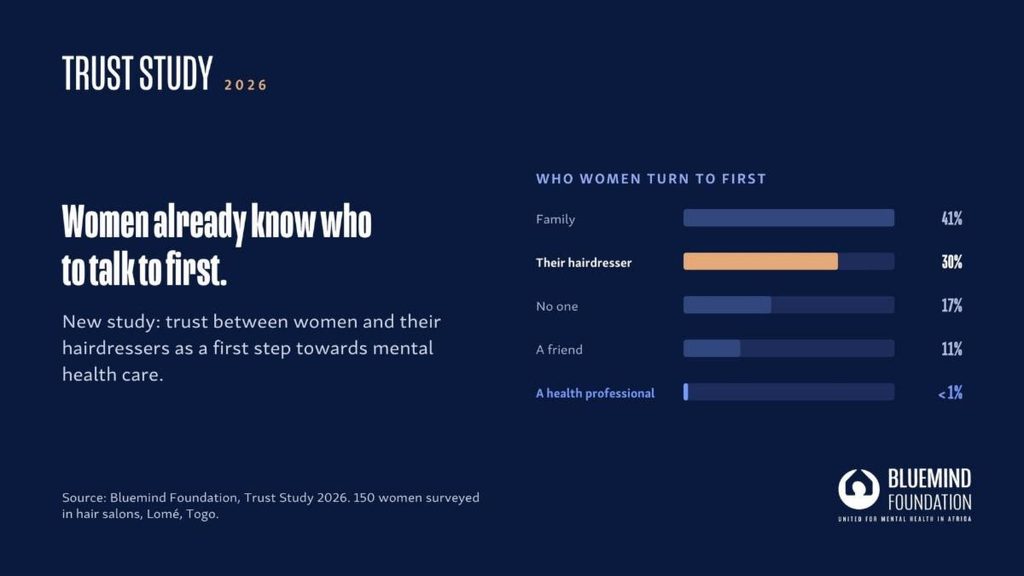
LOME, Togo, 08 October 2026 -/African Media Agency(AMA)/ – When facing a difficulty, 30% of women surveyed in Togo say they first turn to their hairdresser. Fewer than 1% name a health professional.
The findings come from the Trust Study, released today by Bluemind Foundation ahead of World Mental Health Day on Oct. 10, which this year focuses on lived experience. The exploratory mixed-methods study involved 576 women (205 clients and 371 hairdressers) in Lomé, Kara, Sokodé and Dapaong between April and June 2026. It asks a question often missing from debates about the mental health treatment gap: what happens before someone reaches the health system, and whom do they trust enough to speak to first?

Among the findings
- 30% of clients surveyed turn first to their hairdresser, after family (41%) and ahead of friends (11%). Fewer than 1% turn first to a health professional.
- 89% of clients interviewed in depth say they tell their hairdresser things they say nowhere else.
- 100% of hairdressers interviewed say they have noticed a client was struggling before she put it into words.
- 99% of clients surveyed would accept, or consider, a referral to professional support from their hairdresser (69% yes, 30% maybe).
The study does not suggest that hairdressers should become therapists. It identifies what makes some everyday relationships matter for mental health: repeated contact over time, discretion, nonjudgment, and a degree of distance from family and close friends. Close, but not too close.
That relationship over time also makes change visible. A hairdresser may notice that a regular client is quieter, more withdrawn or different from usual, sometimes before she says anything.
“Women often already know who they trust enough to speak to first. The question for health systems is what happens next. Trust can make speaking possible, provide an initial form of support and, when more help is needed, open a path toward care. But a referral is only as useful as the care available at the other end.”
— MARIE-ALIX DE PUTTER, FOUNDER AND PRESIDENT OF BLUEMIND FOUNDATION
Trust already exists. Training changes what can be done with it.
Since 2021, Bluemind Foundation’s Heal by Hair program has trained hairdressers to listen without judgment, keep confidences, recognize signs of distress, respond safely to difficult disclosures, including violence, understand the limits of their role, and refer women to identified professionals.
The Trust Study does not measure the impact of Heal by Hair. It examines the relationship the program is built on. Heal by Hair does not create that relationship; it changes what hairdressers can do with it.

Beyond the salon
For health systems, the implications reach well beyond hair salons. Where does trust already exist in communities, and what role can those relationships play in making support, and when necessary formal care, easier to reach?
The question matters most where specialist care is scarce. Nearly 150 million people in Africa live with a mental health condition, and fewer than one in ten receive any form of support. Togo has fewer than ten psychiatrists for more than 9 million people, according to the World Health Organization.
Trust alone cannot close that gap. Bluemind Foundation argues that community-based pathways must be developed alongside investment in professional services, referral systems and the mental health workforce.
“The goal is not to medicalize everyday relationships. It is to understand the human infrastructure that already exists around people, and to connect it safely to stronger systems of care.”
— MARIE-ALIX DE PUTTER
Research from Africa, for a global question
Mental health research remains scarce in francophone Africa and underrepresented in the global literature. The Trust Study starts from the opposite direction: documenting a relationship observed in Togo, testing what can be learned from it, acknowledging what cannot be generalized, and asking whether similar mechanisms exist elsewhere.
The study is exploratory and descriptive. It does not measure therapeutic impact or establish causality. Its central proposition is one for further research: mental health systems may need to understand not only where care is delivered, but the human relationships through which people first become able to seek support.
Mental health is health.
Download the Trust Study: bluemindfoundation.org/system/evidence
Distributed by African Media Agency (AMA) on behalf of BlueMind Foundation
ABOUT THE TRUST STUDY
Reference: Bluemind Foundation. (2026). Trust Study – Can Trust Be Mental Health Infrastructure? Trust, emotional support, and pathways to mental health care in African hair salons: evidence from Togo. Lomé: Bluemind Foundation.
Fieldwork: April to June 2026; Lomé, Kara, Sokodé and Dapaong, Togo
Participants: 576 women (205 clients and 371 hairdressers)
Methods: 440 questionnaires (150 clients, 290 hairdressers); 53 in-depth interviews (28 clients, 25 hairdressers); five focus groups with 83 participants (27 clients, 56 hairdressers). Data collected by independent enumerators.
Design: Exploratory, descriptive mixed-methods research. The study does not estimate therapeutic effects or causal impact.
ABOUT BLUEMIND FOUNDATION
Bluemind Foundation is an international non-profit organization, born in Africa, working to make mental health support and care accessible to everyone, everywhere, every day. Through research, social innovation and community programs such as Heal by Hair, it explores how resources already present in communities can bring listening, support and care closer together.
Media contact: welcome@bluemindfoundation.org · +228 99 22 00 87
Press kit: Trust Study 2026 – Press kit (EN)
Follow us: LinkedIn · Instagram · Facebook · YouTube · bluemindfoundation.org