

Geneva, Switzerland, 04 February 2026-/African Media Agency(AMA)/-“When I heard the town crier announce that health workers were coming for free screening, I felt afraid: if they told me I had the disease, how would I get treated? But I thought of my children and decided to go,” says Awa, 48, a mother of six living in Ipendo, in Burkina Faso’s Centre-West region.
Like Awa, thousands of women in the country have long lived with this concern, given the challenges in accessing health services. Their situation illustrates a major issue: cervical cancer remains one of the deadliest cancers among women in the country.
Before the implementation of WHO’s global strategy to accelerate its elimination, screening coverage was very low—less than 8%—and rural areas were particularly disadvantaged. Women had to travel dozens, sometimes hundreds, of kilometres to reach an equipped centre, often without financial means for transport or care. Trained health professionals were scarce and awareness was almost nonexistent.
To overcome these obstacles, the Burkinabe government took bold measures, explains Dr Nayi Zongo, oncologist, public health physician and coordinator of the National Cancer Control Programme (PNLC). “The government adopted a decree making screening and treatment of precancerous lesions free of charge. It also equipped some peripheral health centres and introduced mobile clinics to reach women.”
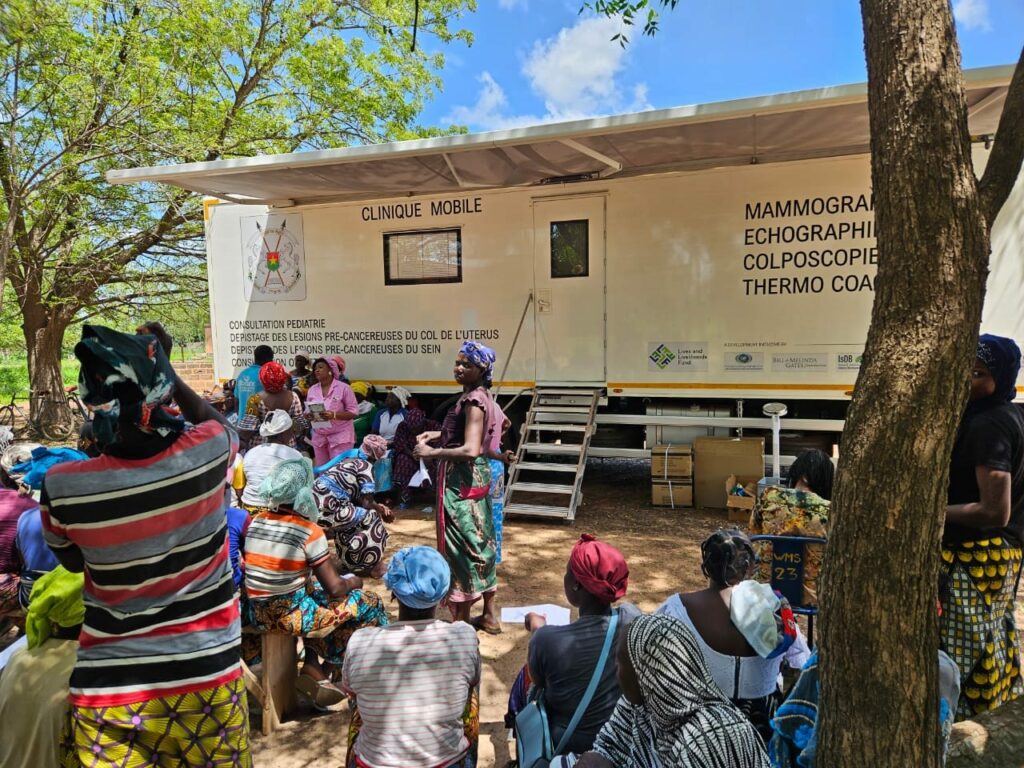
These mobile clinics have become a symbol of health equity: they travel to villages, farms, markets and even family courtyards. Women no longer need to leave their agricultural or domestic activities to get screened. “Screening is brought closer to communities, allowing women to continue their activities while safeguarding their health,” emphasizes Dr Zongo.
The Burkinabe initiative stands out for its synergy of several strategic approaches: removing financial barriers (free care), overcoming geographic barriers through mobile clinics and mobilizing communities. The country also integrated awareness campaigns through TV and radio spots and popular events like “Pink October” and created a national cancer coalition bringing together civil society, community leaders and the media to generate demand. This comprehensive approach has turned the fight against cervical cancer into a national cause.
WHO’s support was crucial in making this vision a reality. The Organization provided technical assistance for developing national guidelines, trained health professionals in detecting and treating precancerous lesions and supported community mobilization. “WHO stood by us to strengthen our capacities and ensure that every woman, wherever she lives, can access this vital service,” says Dr Zongo.
The results are impressive. In just one year, from October 2024 to September 2025, 468 mobile clinic missions were organized in various localities. These missions raised awareness among nearly 2 million women, conducted over 106 000 screenings, performed 715 removals precancerous lesions and carried out over 100 advanced examinations to confirm diagnoses. These figures are more than statistics: they represent lives saved and families preserved.
For WHO, this success illustrates the power of collaboration. “Burkina Faso shows that with strong political commitment and context-appropriate solutions, it is possible to overcome barriers that once seemed insurmountable,” says Dr Seydou Coulibaly, WHO Representative in Burkina Faso. He stresses the exemplary nature of this initiative in Africa: “Removing financial and geographic obstacles through free care and mobile clinics is an inspiring model for other countries.”
In villages, these efforts translate into real stories. Awa, the mother of six, describes her daily life: “We work in the fields, garden and sell vegetables at the market. When we heard about the screening, I was scared. But other women’s testimonies convinced me. On the day of the test, the health workers explained every step. When the result came back negative, I felt great relief. Today, I advise all women to get screened. If the disease is detected early, treatment is easier,” she says confidently.
For many women like Awa, these mobile clinics represent much more than a medical service: they often provide the very first opportunity to hear about cervical cancer, understand the risks, and learn that it can be prevented. This initial information is a decisive step, as it opens the door to prevention and care.
Beyond health, this initiative touches on dignity, social justice, and the future of families. Every mobile clinic that arrives in a village carries a message: health is a right, not a privilege. And in Burkina Faso, that right is becoming a reality.
Distributed by African Media Agency (AMA) on behalf of Word Health Organisation