


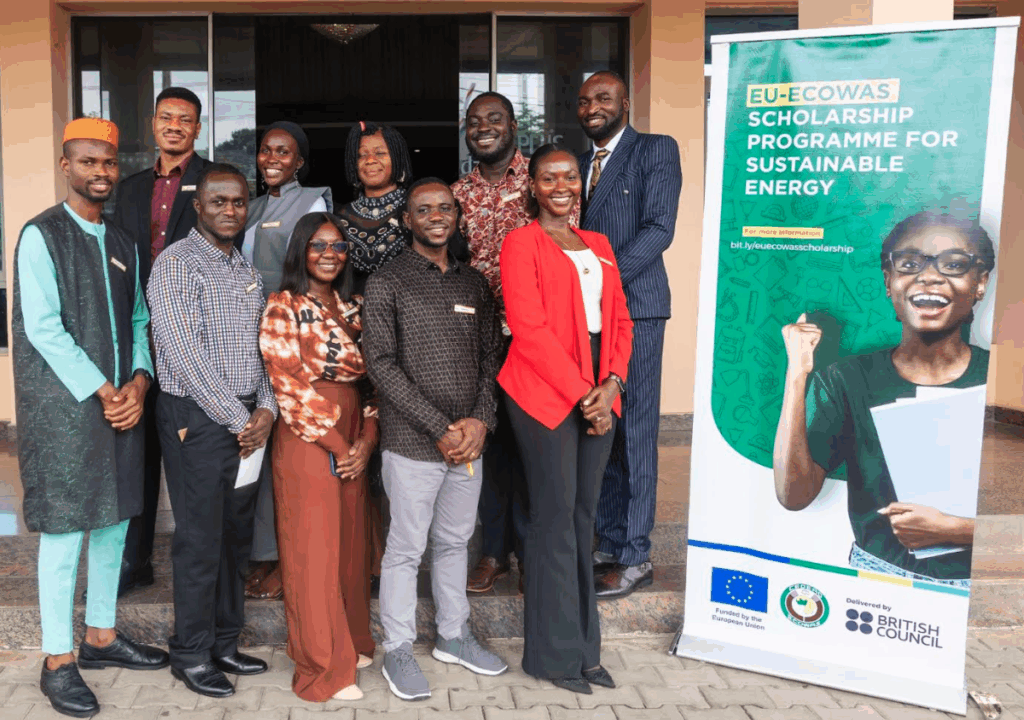
LAGOS, Nigeria, 10 December 2025-/African Media Agency(AMA)/-The EU–ECOWAS Scholarship Programme for Sustainable Energy, funded and launched in September 2022 by the European Union in partnership with the Economic Community of West African States (ECOWAS) and delivered by the British Council, is celebrating the achievements of its first cohort of scholars whose research is already contributing to the region’s green-energy transition.
The programme provides fully funded master’s degrees in sustainable energy at nine specialised higher-education institutions across Cape Verde, Côte d’Ivoire, Ghana, Nigeria, Senegal, and Togo.
Demand for the programme has been exceptionally high. From 10,442 applications, scholarships were awarded to 72 academically outstanding candidates from 11 ECOWAS member states — with over 40% female representation.
The programme aims to strengthen human-capital development in the West African electricity sector by supporting postgraduate training and enhancing the capacity of Higher Education Institutions (HEIs) to deliver high-quality, industry-relevant education in sustainable energy and energy-efficiency systems. Alongside rigorous academic study, scholars received research support and mentorship to advance innovations that directly benefit the region.
All 72 scholars under the programme completed their research work in sustainable energy. Today, we highlight five scholars who illustrate the transformative impact of the programme through research that addresses real-world energy challenges in West Africa — from electric mobility and air-quality monitoring to renewable-energy optimisation, environmental data systems, and national energy-demand reduction.
Research Highlights from Five EU–ECOWAS Scholars
1. Blessing Nneka Ben-Festus (Nigeria)
Research: IoT-Enabled Predictive Maintenance and Energy Optimisation in Modern Inverter Systems
Institution: University of Ibadan, Nigeria
Blessing developed one of the first locally relevant Battery Management Systems (BMS) for Nigeria’s widely used inverter systems. By integrating the Internet of Things (IoT) with machine-learning-based predictive maintenance, the study demonstrates how low-cost hardware and advanced analytics can dramatically improve safety and energy performance in household backup-power systems.
This Battery Management System (BMS) is capable of delivering:
- A three-sensor platform monitoring voltage, current, and temperature
- A remote-data system using an Arduino microcontroller and a Global System for Mobile Communications module
- Machine-learning models achieving 99% accuracy in predicting battery ageing and 92% accuracy in decision-tree diagnostics
- Proven improvements in battery safety, lifespan, and reliability
Impact for ECOWAS: Improved safety, lower household costs, enhanced confidence in decentralised solar and inverter systems, and reduced energy waste across the region.
2. Ruth Mawunyo Kokovena (Togo)
Research: Building a Low-Cost Environmental Monitoring System to Support Renewable Energy Planning
Institution: University of Lomé, Togo
Ruth developed SISEE, an affordable, multi-sensor environmental monitoring system designed for regions where high-precision weather stations are too costly to install or maintain. The system captures temperature, relative humidity, solar irradiation, tide levels, and GPS location, using open-source software and low-cost sensors.
SISEE is capable of delivering:
- Temperature accuracy nearing ±0.5°C, comparable to entry-level commercial stations
- Over 80% correlation in solar-irradiation tracking
- Effective monitoring of tidal variations for coastal energy planning
- Real-time data transmission and visualisation
Impact for ECOWAS: Supports solar-resource assessment, coastal-energy planning, climate-monitoring infrastructure, and decentralised data collection for national energy strategies.
3. Godwin Josiah Ajisafe, (Nigeria) – Under the supervision of Ayodele T. R & Ogunjuyigbe A.S
Research: Determination of the Functional End-of-Life Threshold of Electric Vehicle Lithium-ion Batteries under Urban Lagos Driving Conditions
Institution: University of Ibadan, Nigeria
This study provides the first Lagos-specific model for predicting the end-of-life of Electric Vehicle (EV) lithium-ion batteries under real urban driving and environmental conditions. Machine-learning algorithms — including Support Vector Regression, Random Forest, and Decision Trees — were trained using local data such as temperature, humidity, traffic intensity, driving behaviour, and charging patterns.
The model is capable of delivering:
- Near-perfect predictive accuracy (Coefficient of Determination R² = 0.999)
- Identification of heat and stop-and-go traffic as major contributors to battery degradation
- Strong foundations for EV-fleet management, charging-infrastructure planning, and battery-recycling initiatives
Impact for ECOWAS: Enables realistic EV-policy development, supports circular-economy planning, and strengthens regional capacity for clean transport systems.
4. Kevin Konan N’guessan (Côte d’Ivoire)
Research: TGIME-ES: A Sustainable Energy Management and Solar Integration Solution for National Energy Demand Reduction
Institution: INP-HB, Côte d’Ivoire
Kevin developed TGIME-ES, an intelligent-energy-management solution that reduces electricity consumption while enhancing solar integration. The system was deployed across residential, commercial, and industrial sites.
TGIME-ES is capable of delivering:
- 22,962 kilowatt-hours of energy saved in four months
- 2,149,745 West African CFA francs in cost savings
- 28% reduction in electricity bills
- National-scale modelling showing TGIME-ES can slow demand growth by more than 50%
Impact for ECOWAS: Offers a scalable, locally developed approach to energy-efficiency, reduced grid pressure, and improved adoption of solar technologies.
5. Patience Yaa Dzigbordi Quashigah (Ghana)
Research: Machine-Learning-Based Performance Analysis of Two Low-Cost Sensors for Measuring Carbon Dioxide (CO₂) and Fine Particulate Matter (PM₂.₅)
Institution: Kwame Nkrumah University of Science and Technology (KNUST), Ghana
Patience evaluated two low-cost air-quality sensors, costing approximately USD 100, as alternatives to reference-grade stations costing up to USD 250,000. Using machine-learning calibration, the study improved the accuracy of monitoring carbon dioxide (CO₂), fine particulate matter (PM₂.₅), ultra-fine particulate matter (PM₁), coarse particulate matter (PM₁₀), temperature, humidity, and methane (CH₄).
These sensors are capable of delivering:
- Clear model ranking, with Random Forest performing best
- Reliable environmental data after machine-learning calibration
- Insights into sensor limitations and calibration techniques
- Evidence that low-cost networks can support large-scale monitoring
Impact for ECOWAS: Enhances affordable air-quality monitoring, supports solar-energy forecasting, informs emissions policy, and enables community-level environmental awareness.
Overall Programme Impact
These five research projects demonstrate the success and strategic relevance of the EU–ECOWAS Scholarship Programme for Sustainable Energy. Together, the scholars’ work:
- Strengthens regional capacity for renewable-energy innovation
- Provides scientific evidence for policy and infrastructure planning
- Supports environmental monitoring and public-health initiatives
- Advances energy efficiency, electric mobility, and solar deployment
- Builds a new generation of skilled experts driving West Africa’s green-energy transition
The programme is creating a pipeline of talented professionals equipped to support ECOWAS member states in accelerating sustainable-energy adoption, reducing emissions, and improving energy security across the region.
Distributed by African Media Agency (AMA) on behalf of British Council